Give each ad, listing and website source its own phone number, and automotive call tracking shows which marketing makes shoppers call your dealership or shop. Call scoring then grades every conversation: did the agent ask the caller's name, find out what they need, and book the visit? Together they show which spend books appointments.
What is automotive call tracking?
A shopper taps the number on your search ad to ask about trade-in value. Call tracking logs that call with its source, the time, the store that took it and whether anyone picked up. It works by giving each source its own tracking number: the search ad, the map listing, the listing site, the direct-mail piece, the website. Each one forwards to the lines your team already answers, so your main number stays the same and nobody changes how they take a call.
On your website, dynamic number insertion shows each visitor a number tied to the campaign that brought them. Paid search, organic and social traffic then split cleanly in your reports.
Both sides of an automotive business run on the phone:
- Sales calls
- Shoppers ask about a vehicle, a price or a test drive.
- Service calls
- Drivers ask about an appointment, a repair or a set of tires.
Call tracking sorts both by source. Your marketing reports then count the shoppers who picked up the phone, not only the ones who filled in a form.
Tracking has a limit. It tells you the phone rang, but not whether the call booked a visit. Call scoring does that part: it grades each conversation on the behaviors that move conversion. If you're new to the basics, start with what call tracking is. The rest of this guide shows what automotive calls reveal once they're scored.
What do the best automotive calls do differently?
They do four things on the same call:
- The agent asks for the caller's name.
- The agent stays highly polite.
- The agent uses ownership language.
- The agent finds out what the caller needs.
In Convirza's causal study of 874,482 automotive calls over seven months, calls that combined all four converted 75.2% of the time. That is nearly 30 points above the study's 45.8% baseline, and all four habits are in the agent's control, so all four can be coached. To count, a call had to score 80 or higher on politeness and 70 or higher on both ownership language and determining needs.
Measured one at a time, ownership language carries the most weight, and asking the caller's name sits close behind. Each lift is measured on its own, so the lifts overlap rather than add up:
- Ownership language: +19.8 points
- This is the strongest single lever in automotive. The agent frames the vehicle, the repair or the visit as something the customer owns and is investing in, not something being sold to them.
- Asking the caller's name
- This comes close behind. It's the simplest of the four and the easiest to hear on a recording.
- Determining needs: +12.8 points
- The agent finds out what the caller drives, what's wrong or what they're shopping for before quoting anything. A price quoted before discovery gives the caller a number to compare, not a reason to come in.
How the study measured it
These are causal estimates, not correlations. The study compared otherwise similar calls using propensity-score matching and double machine learning, and the results passed placebo and subset refutation tests. The method is built to separate what the agent did from who happened to call.
For your stores, this means a booked visit isn't only up to the caller. Four habits move it, your team either uses them on a call or doesn't, and call scoring shows you which. To see what closing part of that gap could be worth at your call volume, get your benchmark report.
How do you monitor sales and service lane calls?
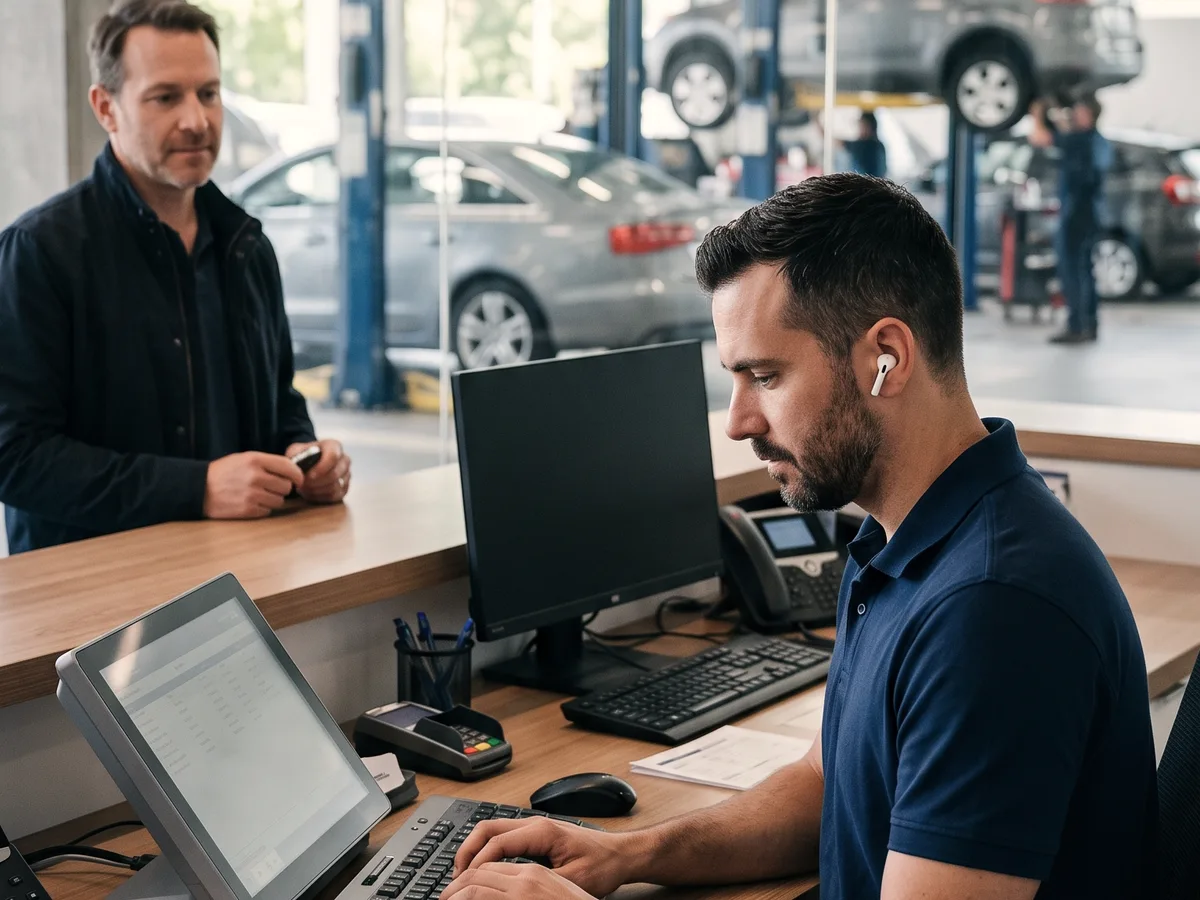
In a dealership or shop, call monitoring means listening to sales and service calls, scoring them and coaching from what you hear. Done by hand, it means sampling: a manager pulls a few recordings a week and hopes they're typical. So the real choice is whether to keep coaching from a handful of calls, or to score every call and coach from what happened. Scoring 100% of calls replaces the sample with the whole picture. Each advisor and salesperson is measured on all of their calls, not the few that happened to get reviewed.
Sales and service calls run through the same platform, but they shouldn't be judged the same way:
- Sales lane
- A shopper asking about trade-in value.
- Service lane
- A driver asking about a brake noise.
Each needs a different conversation, so you split results by call type, location, advisor or campaign, and score each lane on its own terms.
Coach from calls you can play back
Splitting by lane makes coaching specific. "Be friendlier on the phone" becomes something you can play back. A service manager can put a call where discovery was skipped and the caller hung up without booking next to one where the advisor asked the right questions and set the appointment.
Do car dealerships record phone calls?
Dealerships can record calls where state law allows it, and the rules on who must consent differ from state to state. Check the rules for every state where you have a store in the call recording laws by state guide, settle it store by store before you record sales and service calls, and confirm your setup with your own counsel.
How do multi-store groups compare locations?
Groups compare locations by putting the same scorecard at every store. When every location's calls are graded on the same behaviors, the gap between your best store and your weakest shows up in the data, not in a hunch. You can see which location asks for names, which one skips discovery and which one lets calls go unanswered.
Group size doesn't change the method. A single rooftop and a regional group use the same tools on a platform that runs from one location to 72,000+, and the group adds location-by-location comparisons.
One 200+ location auto service network moved from sampling to scoring every call:
- Call review went from 4% of calls, reviewed by hand, to 100% scored.
- Automated scoring reached 95%+ accuracy, against 85% for the manual review it replaced.
Read the multi-location automotive case study.
When do auto shop calls peak?
In Convirza call data, auto shop calls peak between 11 AM and 12 PM, measured as a share of the day's calls.
Staff the phones for the hour before noon, not for the hour you unlock the doors. If lunch breaks fall on the same people who answer the phone, your busiest calls get the thinnest coverage. Call tracking shows the pattern for your own stores by hour, day and location, so you can set schedules from your own data.
What should a dealership or shop set up first in Convirza?
Go in this order.
- Begin with your biggest spend: search ads, map and listing profiles, direct mail, and your website through dynamic number insertion. Put a tracking number on each, forwarded to your existing lines.
- Let Conversation Analytics scoring grade each sales and service call on the habits that move conversion.
- Review the scores by source, store and agent, then build your coaching sessions around the calls that slipped.
Then choose where your team reads the scores:
- In the platform
- Tracking numbers, recordings and scores by source and location, in one dashboard.
- Through the API
- Pull calls, sources and scores into your own reporting. Start with the developer docs at docs.convirza.com.
- In your AI assistant
- Connect Claude, ChatGPT, Cursor, VS Code or Codex to Convirza's hosted MCP server at connect.convirza.com/mcp. It uses OAuth and acts with your role, so you can ask, in your own words, which source drove the most calls last week.
For how Convirza works across service lanes and dealer groups, see Convirza for automotive.